
An educational institution may attract thousands of visitors to its website, generate considerable engagement across its social media channels, and receive inquiries about its programs—yet still fall short of its enrollment targets.
The problem is not always a lack of visibility. In many cases, it stems from the absence of a clear pathway that guides prospective students from discovering the institution to exploring its programs, comparing their options, and ultimately deciding to enroll.
This challenge becomes more significant when institutions rely on paid advertising or disconnected marketing activities without a strategy that aligns these efforts with the student journey and its evolving needs. A prospective student, for example, may discover a useful article through a search engine but leave the website without knowing which program to explore or what step to take next.
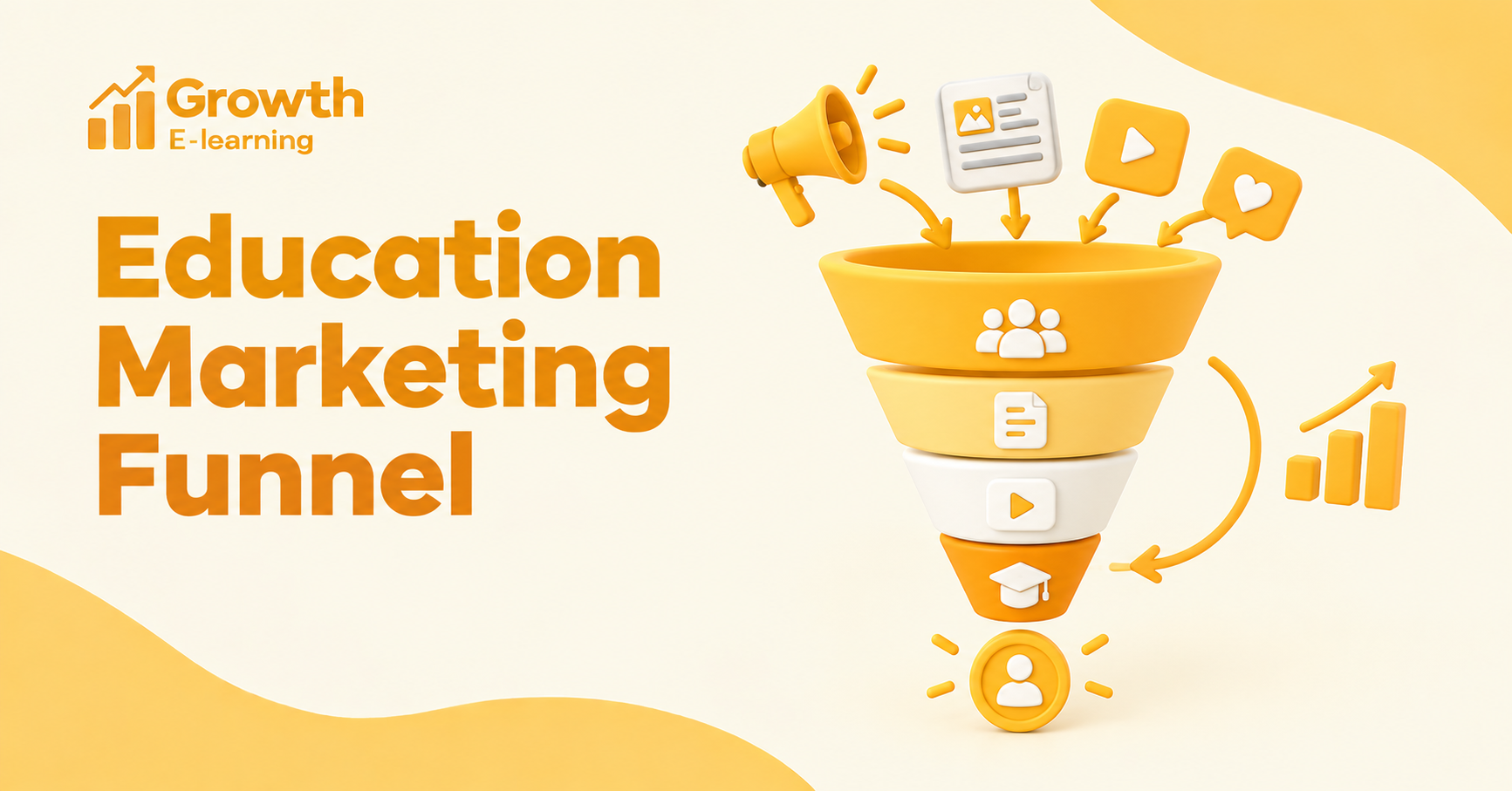
This is where the Education Marketing Funnel comes in. It provides a framework for understanding the prospective student journey, delivering relevant information at each stage, and measuring how effectively marketing efforts translate interest into tangible outcomes.
In this article, we explore the education marketing funnel, its key stages, and the role content and blogging can play in supporting the student journey. We also explain how educational institutions can develop a content strategy that strengthens their online visibility and attracts students whose needs align with their programs.
What Is an Education Marketing Funnel?
An education marketing funnel is a framework that maps the stages prospective students go through, from discovering an educational institution or one of its programs to researching their options, evaluating alternatives, applying, and eventually enrolling.
It is called a funnel because the number of people who discover an institution is typically larger than the number who progress toward enrollment. Thousands of people may read an article about a particular field of study, while a smaller number visit program pages, some request additional information, and only a portion submit applications and complete enrollment.
This does not mean every institution will achieve the same conversion rates or that every student follows the same sequence. The journey varies depending on the program, target audience, cost of study, admission requirements, and the time students need to make a decision.
How Does an Education Marketing Funnel Differ from a Traditional Sales Funnel?
An education marketing funnel shares the same overarching goal as a traditional sales funnel: turning audience interest into a specific action. However, choosing an educational program often involves more extensive research, comparison, and evaluation than many everyday purchasing decisions.
Students do not evaluate programs based on price alone. They may also consider how well a program aligns with their career goals, the skills they will acquire, the curriculum, instructors' experience, learning format, certification or accreditation, and the potential value of completing the program.
Educational institutions therefore need content that addresses these questions and provides clear, useful information to support informed decisions—not just promotional messages.
What Is the Difference Between a Marketing Funnel, an Admissions Funnel, and an Enrollment Funnel?
Terms such as Education Marketing Funnel, Admissions Funnel, and Enrollment Funnel are sometimes used interchangeably, but they can refer to different parts of the student journey.
- Education Marketing Funnel: Focuses on attracting the right audience, building awareness and interest, and encouraging prospective students to engage with the institution and its programs.
- Admissions Funnel: Focuses on moving prospective students from initial inquiries and applications through admission requirements and the admissions decision.
- Enrollment Funnel: Focuses on moving students from interest or acceptance to completing the necessary enrollment procedures.
These processes overlap in practice. Educational institutions should therefore treat them as interconnected parts of one student journey while defining the responsibilities of marketing, admissions, and enrollment teams and establishing appropriate performance indicators for each stage.
Why Is an Education Marketing Funnel Important for Educational Institutions?
An education marketing funnel helps institutions move from disconnected marketing activities to a more structured approach that aligns the student journey with enrollment goals.
Its benefits include the following.
1. Aligning Marketing Activities with the Student Journey
Instead of publishing generic content or launching unrelated advertising campaigns, institutions can identify what students need at each stage and select the messages and channels that help them take the next step.
2. Attracting Better-Fit Prospective Students
More website visitors do not necessarily mean a better audience. When institutions publish content that addresses students' actual interests and questions, they increase their chances of reaching people whose needs align with the programs they offer.
3. Improving the Conversion of Interest into Enrollment
A funnel helps institutions identify gaps between stages. If a website attracts substantial traffic but few visitors explore program pages, the institution may need to improve internal linking or publish content that connects more directly to its programs.
If inquiry volume is healthy but enrollment remains low, the problem may lie in unclear application procedures, inadequate follow-up, or missing information that students need before making a decision.
4. Identifying Where Prospective Students Lose Interest
By measuring how students progress through the funnel, institutions can identify drop-off points and determine where content, website experience, or communication needs improvement.
5. Making Better Use of Marketing Budgets and Resources
Tracking results helps institutions understand which activities attract relevant audiences and support conversions, rather than judging marketing success solely by website traffic or engagement.
What Are the Stages of an Education Marketing Funnel?
An education marketing funnel can be divided into five core stages leading to enrollment, followed by a stage focused on student retention and advocacy. The exact stages and terminology may vary depending on the institution and the programs it offers.
1. Awareness
At this stage, prospective students begin discovering an educational field, specialization, or institution that might help them achieve a particular goal. They may not yet know which program is right for them or which institutions they should consider.
For example, someone looking to change careers may search for the skills required to enter data analytics, while a recent graduate may explore specializations that could improve their career prospects.
How can educational institutions reach prospective students at this stage?
By publishing content that answers their initial questions and helps them understand the field and available options, such as:
- Educational articles explaining foundational concepts.
- Beginner-friendly guides.
- Articles about the skills required in a particular field.
- Content exploring educational and career pathways.
- Educational social media posts and videos.
A blog can help an institution appear in search results when people look for these topics—even before they know the institution's name or are aware of its programs.
At this stage, not every visitor needs a direct enrollment prompt. It may be more appropriate to guide them to a related article or resource that helps them explore the subject further.
2. Interest
After discovering a field or institution, prospective students begin exploring options that may meet their needs. They may move from general searches to researching a specific specialization, the skills taught in a particular program, or the differences between available learning pathways.
For example, someone who reads an article about data analytics may go on to research the skills data analysts need or the training programs that can help them develop those skills.
What content works best at this stage?
- More specialized articles about the field and its required skills.
- Guides explaining possible learning pathways.
- Content about choosing the right educational program.
- Articles connecting acquired skills with professional needs.
- Program pages that help students explore an institution's offerings.
The goal is to help prospective students move from general interest to exploring more specific options without assuming they are ready to enroll immediately.
3. Consideration
At this stage, prospective students begin evaluating alternatives and comparing programs and institutions against criteria that matter to them.
They may consider the curriculum, admission requirements, study duration, delivery format, instructors' experience, cost, and alignment with their goals. They may also want to understand what distinguishes one program from another and what they can expect in return for their investment of time and money.
How can institutions help students compare their options?
By providing clear, comprehensive information through resources such as:
- Program pages explaining objectives, curriculum, and requirements.
- Articles comparing specializations or learning pathways.
- Guides to choosing the right program.
- Answers to frequently asked questions about study and assessment.
- Verified student stories and testimonials, where available.
- Clear information about expected outcomes and what the program can realistically deliver.
These resources help students assess whether a program meets their needs. They also give institutions an opportunity to demonstrate their programs' value through evidence and useful information rather than relying on promotional claims.
4. Decision
Prospective students reach this stage when they are more prepared to take action, such as requesting additional information, contacting the admissions team, or beginning an application.
However, questions or concerns may still delay their decision. They may need clarification about admission requirements, upcoming start dates, program suitability, or the enrollment process and associated costs.
What should institutions provide at this stage?
- Clear, detailed program pages.
- Straightforward explanations of admission and application requirements.
- Accurate answers to common questions and concerns.
- Relevant, verifiable success stories and student experiences.
- Clear calls to action, such as requesting program details, booking a consultation, or starting an application.
- Accessible communication channels for additional support.
Calls to action should match the student's needs. Some visitors may be ready to apply, while others may need to review a program guide or speak with a representative before deciding.
5. Enrollment
At this stage, students move from interest or application to completing the procedures required to enroll in a program.
However, reaching this stage does not guarantee completed enrollment. Students may drop off because the next steps are unclear, documents are missing, deadlines or requirements are confusing, or responses to their questions are delayed.
Institutions should therefore make the enrollment process as clear as possible and provide appropriate support to students who need it.
Helpful resources and practices include:
- Guides explaining the application and enrollment process.
- Pages listing required documents and important deadlines.
- Follow-up messages that clearly explain the next step.
- Answers to frequently asked questions during enrollment.
- Coordinated communication between marketing, admissions, and enrollment teams.
At this stage, a straightforward process, timely responses, and clear information can reduce hesitation and help students complete enrollment.
6. Retention and Advocacy
The relationship between an institution and its students does not end when enrollment is complete. The student experience can influence satisfaction, continued participation, and willingness to recommend the institution to others.
Institutions can support students through study preparation guides, supplementary resources, content explaining how to get the most out of a program, and communication that helps them engage with the learning experience.
When students have positive experiences, institutions can invite them to share their feedback or recommend the institution without pressuring them or implying that every student will achieve the same results.
What Content Works Best at Each Stage of the Education Marketing Funnel?
Educational institutions need to diversify their content according to students' needs at each stage, rather than publishing similar articles or directing every visitor straight to the enrollment page.
The following table illustrates how content can align with student needs and institutional goals.
Funnel stage | Content objective | Examples of suitable content |
Awareness | Attract relevant audiences and answer initial questions | Educational articles, beginner's guides, articles about skills and specializations |
Interest | Help students explore fields and options | Specialized guides, career pathway articles, content about required skills |
Consideration | Help students evaluate alternatives | Program comparisons, curriculum and requirement explanations, program selection guides |
Decision | Build confidence and clarify the next step | Program pages, FAQs, verified student stories, application guides |
Enrollment | Make the process easier to complete | Enrollment instructions, required-document checklists, deadline information, follow-up messages |
Post-enrollment | Support the student experience and encourage retention and advocacy | Study preparation guides, supplementary resources, content that helps students benefit from their programs |
A single piece of content may support more than one stage, depending on its topic, presentation, and the links it includes.
What matters most is that every piece of content has a clear purpose and helps readers move toward a logical next step based on their needs.
This is where an educational blog becomes valuable: rather than functioning as a collection of unrelated articles, it can become part of an interconnected content system that helps students discover a field, explore programs, and find the information they need before making a decision.
How to Build a Content Strategy That Supports the Education Marketing Funnel
Publishing SEO-friendly articles is not enough to achieve marketing goals. Institutions need a strategy that defines which topics to cover, whom to address, which funnel stage each article supports, and how its impact will be measured.
The following steps provide a practical starting point.
1. Identify Your Target Audience and Their Needs
Start by identifying the audiences the institution wants to reach, the programs it aims to promote, and the questions prospective students ask before choosing a program.
The needs of someone looking for their first training program may differ from those of a professional seeking to develop new skills, a student comparing university programs, or a parent evaluating educational options for their child.
The more accurately an institution understands its audience, the easier it becomes to select useful topics and create content that addresses genuine needs.
2. Research Keywords and Student Questions
Keyword research helps institutions understand what their audiences search for, how they express their needs, and which information they want to find.
However, the process should not be limited to keywords directly related to program names. A student's journey may begin with general questions about a field, skill, or career pathway before progressing to searches for programs that can help them achieve their goals.
It is therefore useful to group keywords and topics by search intent, such as:
- Informational intent: What is data analytics? What skills are required for a career in digital marketing?
- Exploratory intent: How do I choose the right specialization? What is the difference between business administration and marketing?
- Comparison and evaluation intent: How do I choose a training program? What should I evaluate before enrolling?
- Action-oriented intent: What are the admission requirements? How do I enroll in the program? When does registration open?
Not every article needs to target the same primary keyword. Instead, the content strategy should cover relevant topics and questions naturally and systematically.
3. Map Content Topics to Funnel Stages
Once the audience and keywords have been identified, organize topics according to student needs and institutional goals.
For example, an institution offering business administration programs might create a content cluster that includes:
- An article about the essential skills required in business administration.
- An article exploring career paths available to graduates in the field.
- A guide to choosing the right business administration program.
- A detailed landing page for the institution's program.
- An article answering frequently asked questions about the program and its admission requirements.
This approach connects individual articles into a coherent journey, helping readers move from learning about a field to evaluating a specific program.
4. Build Topic Clusters and Relevant Internal Links
Content can be organized into topic clusters, with a main article covering a broad subject and related articles addressing more specific questions.
These articles can then link to relevant program pages, guides, and resources through clear internal links.
For example, an article about the skills required in a particular field could link to an article explaining how to develop those skills, followed by a program page describing the curriculum and admission requirements.
This structure helps readers explore relevant information while making it easier for search engines to discover pages and understand the relationships between topics. Google's official SEO Starter Guide provides guidance on website structure, internal links, and making content discoverable.
5. Optimize Content for Search Engines and Readability
Every article should answer a clear question, provide useful and comprehensive information, and use descriptive titles and headings that help readers find what they need.
Essential practices include:
- Choosing a title that accurately reflects the article's subject.
- Using the primary keyword and related terms naturally.
- Organizing the article with clear subheadings.
- Including examples and tables when they help explain complex information.
- Linking to related articles and relevant program pages.
- Reviewing accuracy and updating information when necessary.
- Providing sources or explaining the author's relevant expertise where appropriate.
Google's guidance on creating helpful, reliable, people-first content emphasizes delivering genuine value to readers rather than simply rewriting competing pages or producing content solely to attract search traffic.
6. Use Calls to Action That Match the Funnel Stage
A call to action (CTA) clarifies what readers can do next after consuming a piece of content.
Its effectiveness depends on how well it matches the reader's needs.
In an educational article, it may be more appropriate to direct readers to a related resource. An article that helps them compare programs could link to a detailed program page, a requirements guide, or an information request form.
For readers who are ready to apply, a CTA inviting them to begin the enrollment process may be more suitable.
The goal is not to ask every visitor to enroll immediately, but to help each reader take a logical next step based on their level of interest and readiness.
7. Update Content and Measure Performance Continuously
A content strategy does not end when articles are published. Institutions need to review performance to identify which topics attract relevant audiences, which pages encourage readers to continue exploring, and which pieces of content need improvement.
Tools such as Google Search Console can help analyze search visibility, while Google Analytics can provide insights into visitor behavior and measurable conversions. These tools can be supplemented with inquiry and enrollment data available to the institution.
The findings should inform practical decisions, such as updating an older article, expanding a topic that attracts relevant interest, improving internal links, or refining a call to action.
Which Marketing Channels Support the Education Marketing Funnel?
Different marketing channels serve different purposes throughout the student journey. They are generally more effective when coordinated within a unified strategy rather than managed in isolation.
Key channels include the following.
Search Engine Optimization (SEO)
SEO helps make an institution's content discoverable to people searching for relevant subjects, specializations, or programs. A blog can support this effort by addressing students' questions and linking articles to relevant program pages and resources.
Blogging and Content Marketing
Content helps explain concepts, answer questions, and build a deeper understanding of educational programs. Articles can also be repurposed for email newsletters, social media posts, and other distribution channels.
Social Media
Social media helps distribute content, reach new audiences, encourage engagement, and direct interested users to relevant articles or program pages.
Paid Advertising
Paid campaigns can expand reach among target audiences or promote specific programs and enrollment periods. Their effectiveness depends partly on directing users to landing pages that match their interests, rather than expecting the advertisement alone to persuade them to enroll.
Email Marketing and Lead Nurturing
Email can deliver information tailored to students' interests, including program guides, deadlines, and answers to frequently asked questions. Messages should remain relevant to recipients and comply with applicable consent requirements and regulations.
Direct Communication and Admissions Teams
Some prospective students need personalized answers before applying or enrolling. Coordination between marketing and admissions helps ensure consistent information, identify where inquiries originate, and follow up with students who need additional support.
These channels work together when content attracts the right audience, advertising and distribution expand its reach, program pages provide the information students need, and communication and admissions teams help them take the next step.
How to Measure Education Marketing Funnel Performance
Performance measurement begins with selecting indicators that match the institution's goals and the funnel stage being evaluated. An educational article should not necessarily be expected to deliver the same outcome as a program landing page targeting people who are ready to apply.
It is useful to group metrics into three categories.
Awareness and Reach Metrics
These indicators help institutions understand whether they are reaching their intended audiences. They include:
- Organic traffic to the website and blog articles.
- Search impressions.
- Search clicks and click-through rate.
- Pages attracting new visitors.
- Traffic sources and channels generating visits.
Interest and Engagement Metrics
These indicators help institutions understand whether content encourages visitors to continue exploring the website. They include:
- Visits to program pages.
- Click-throughs from articles to relevant pages.
- Engagement with internal links and calls to action.
- Requests for additional information.
- Event registrations or guide downloads, where applicable.
Conversion and Enrollment Metrics
These indicators help evaluate whether interested prospects progress toward more advanced actions. They include:
- Number of qualified inquiries.
- Inquiry-to-application conversion rate.
- Application-to-enrollment conversion rate.
- Number of completed enrollments.
- Cost per acquired student, when sufficient cost and attribution data are available.
- Time taken to move between funnel stages.
The conversion rate between two stages can be calculated as follows:
Conversion rate = Number of people who progressed to the next stage ÷ Number of people in the previous stage × 100
For example, if an institution receives 200 qualified inquiries and 40 people complete applications, its inquiry-to-application conversion rate is 20%.
This metric helps evaluate progression between the two stages. However, it does not explain why the remaining prospects did not complete their applications. Institutions should interpret it alongside follow-up data and user behavior.
How to Measure the Blog's Contribution to Enrollment
Blog performance should not be judged by traffic alone. An article may attract a large number of visitors without clearly contributing to the institution's goals, while another article may attract fewer visitors but help readers explore a specific program or request information.
Useful indicators include:
- Articles attracting organic traffic relevant to the institution's programs.
- Click-throughs from articles to program pages.
- Inquiries originating from or influenced by content.
- Content-assisted conversions.
- Topics attracting prospective students who are a strong fit for the institution's programs.
Institutions should not assume that every enrollment occurring after an article visit was caused by that article. Students may interact with several channels before making a decision. Measuring content's contribution therefore requires appropriate tracking, clearly defined conversions, and an understanding of the limitations of the attribution methods being used.
What Are the Common Mistakes in an Education Marketing Funnel?
Educational institutions may carry out numerous marketing activities without achieving their desired outcomes because the stages of the student journey are disconnected or the content does not match students' needs.
Common mistakes include the following.
1. Relying on Advertising Without Building Supporting Content
Advertising can expand reach, but it cannot answer every student question on its own. Without useful content and clear landing pages, visitors may struggle to understand a program or assess whether it meets their needs.
2. Publishing Generic Content That Does Not Address Audience Needs
Publishing a large number of articles about broad educational topics is not enough. Topics should relate to the target audience, the institution's programs, and the questions students need answered.
3. Directing Every Visitor Straight to Enrollment
Not every visitor is ready to apply. Some may benefit more from a related article, an educational guide, or a program page before being asked to make a bigger commitment.
4. Neglecting the Consideration Stage
Students may need to compare programs or understand admission requirements, costs, and study formats before making a decision. If this information is difficult to find, they may look elsewhere.
5. Failing to Connect Articles with Program Pages
When an article ends without suggesting a relevant next step, readers may benefit from the information but leave without exploring the institution's offerings. Relevant internal links help create a clearer pathway between educational content and programs.
6. Measuring Success Only Through Traffic and Inquiries
Some website visits may come from people outside the intended audience, and not all inquiries become applications or enrollments. Marketing performance should therefore be connected to later-stage outcomes, while recognizing that conversion challenges may also stem from admissions or enrollment processes.
7. Failing to Update Content or Analyze Performance
Information can become outdated, and student needs can change over time. Updating content and reviewing performance data help institutions maintain accuracy, improve relevance, and identify opportunities to strengthen existing resources rather than continually publishing new articles without reviewing what is already available.
How Can an Educational Blog Improve the Marketing Funnel?
An educational blog can play an important role in the education marketing funnel when it is built around student needs, connected to relevant program pages and next steps, and managed as part of a clear content strategy.
Its contribution can take several forms.
Attracting Prospective Students Through Search Engines
Educational articles can answer questions students ask before identifying the institution they want to attend. This gives institutions an opportunity to demonstrate their expertise and reach relevant audiences through organic search.
Answering Questions Before Students Contact the Institution
Content can explain concepts, skills, learning pathways, and program requirements, helping students develop a clearer understanding before contacting the admissions team.
Building Trust Through Useful, Specialized Content
Accurate and clear content that provides genuine value helps demonstrate an institution's knowledge of its field and its understanding of audience needs. Content should be based on reliable information and avoid unsupported promises or claims the institution cannot substantiate.
Supporting Program Pages with Relevant Content
Educational articles can link to program pages, providing additional information for readers who want to move from exploring a subject to evaluating a specific program. In this way, the blog becomes more than a traffic source: it becomes part of the website experience and conversion journey.
Encouraging Readers to Take the Next Step
Internal links and relevant calls to action can guide readers toward the content or page that best meets their next need. The next step should be clear and related to the article's topic, rather than a generic enrollment prompt added to every page.
Building a Sustainable Source of Organic Traffic
Useful content can continue attracting visitors over time, although results depend on factors such as competition, content quality, and audience needs. A blog does not replace other marketing channels, but it can help institutions diversify their sources of student acquisition and reduce complete dependence on paid campaigns.
Realizing these benefits requires more than writing and publishing articles. It calls for an editorial plan, keyword research, alignment between content topics and institutional goals, website optimization, and continuous performance monitoring.
Frequently Asked Questions About the Education Marketing Funnel
What Is the Difference Between an Education Marketing Funnel and an Enrollment Funnel?
An education marketing funnel focuses on attracting prospective students and building their interest in an institution and its programs. An enrollment funnel focuses on moving those students toward completing enrollment procedures. Both are interconnected parts of the student journey, from discovery to enrollment.
What Are the Main Stages of an Education Marketing Funnel?
Common stages include awareness, interest, consideration, decision, and enrollment. Institutions can also include a retention and advocacy stage after enrollment. The exact stages may vary depending on the institution and its programs.
How Can Educational Institutions Attract More Prospective Students?
Institutions can attract prospective students by understanding their audience, publishing useful content, improving search visibility, using appropriate distribution channels, and providing clear program pages. The priority should be attracting people whose needs align with the available programs, not simply increasing website traffic.
What Role Does a Blog Play in the Education Marketing Funnel?
A blog helps attract students searching for relevant information, answer their questions at different stages of the journey, and connect them with program pages and resources that support their evaluation process. Its value increases when it is managed through an integrated content strategy and measured against institutional goals.
How Can Institutions Measure the Success of an Education Marketing Funnel?
Institutions can measure performance using stage-specific indicators such as organic traffic, visits to program pages, qualified inquiries, conversion rates between stages, applications, and completed enrollments. These metrics should be used to identify gaps and improve performance rather than simply generate reports.
Can the Education Marketing Funnel Be Used by Universities, Training Centers, and E-Learning Platforms?
Yes. The framework can be applied to universities, institutes, training centers, and e-learning platforms. However, institutions should adapt the stages, content, and performance indicators to their programs, target audiences, enrollment processes, and decision-making journeys.
Turn Your Educational Blog into Part of Your Growth Strategy
An educational blog is not simply a way to increase website traffic. It can become part of a broader system that helps prospective students discover programs, understand their value, compare available options, and identify the most relevant next step.
Achieving this requires a content strategy that connects audience needs with relevant keywords, identifies topics for each stage of the student journey, links articles to program pages and related resources, and continuously evaluates performance to identify what works and what needs improvement.
At Growth E-learning, we help educational institutions strengthen their digital presence and develop SEO-driven content strategies that support audience reach and connect content with marketing and growth objectives. An effective blog is not necessarily the one that publishes the largest number of articles. It is the one that delivers useful content through a clear strategy and helps turn digital visibility into more valuable opportunities.
Explore Growth E-learning's content and SEO services to discover how strategic content can support growth and enrollment for educational institutions.